
In the parts of Brentwood that moved from septic tanks to a pressure sewer, each house runs on a grinder pump, and the homeowner owns that pump. When it stops moving wastewater out, the water has nowhere to go but back into the house. A flashing red light, slow toilets and gurgling drains are the three warning signs, and each one deserves attention the moment it appears.
Key takeaways
- A flashing red light, slow toilets and gurgling drains are the three warning signs of a grinder pump problem in Brentwood septic to sewer conversion areas.
- The grinder pump is owned by the homeowner, so the repair is the owner's job and a plumber or pump technician handles the equipment.
- Cut water use the moment a warning sign shows, because every flush, shower and load of laundry adds to what the pump cannot move.
- Wastewater that backs up into a house is a sewage loss, so porous materials it touches are removed rather than dried.
- Fixing the pump does not finish the job: extraction, disinfection and structural drying still have to happen.
Why a grinder pump backup lands on the homeowner
Brentwood has areas that were converted from septic systems to sewer service. Those areas run on a pressure sewer, where a grinder pump at each house chops waste and pushes it out under pressure.
The pump sits on the homeowner's property and is owned by the homeowner. That makes a failed pump a household equipment problem, not a street problem, and it can fill a bathroom, a laundry room or a finished lower level.
Most Brentwood homes are large single family houses built in subdivisions from the 1980s to the 2000s, with newer construction mixed in. A backup in a house that size can spread across a lot of floor before anyone sees it.
The three warning signs, one at a time
Each sign points at the same trouble from a different direction. Learning them separately helps an owner act while the problem is still small.
- Several fixtures slowing down at once, not a single clogged toilet.
- The lowest drain in the house acting up first, such as a basement floor drain or a ground level bathroom.
- A gurgle at one fixture when another fixture is used.
- A light that flashes while the water supply and power in the house are otherwise normal.
A flashing red light
The red light is the pump's own alarm. A flashing light usually means the pump tank is filling faster than it empties, or the pump has stopped working.
It is the earliest warning an owner gets, and the best chance to stop a backup before water reaches a fixture.
Toilets that drain slowly
A toilet that flushes weakly or fills the bowl slowly, while the rest of the house seems normal, points past the fixture toward the pump tank.
The wastewater is not leaving fast enough, so each flush has to push against what is already waiting.
Gurgling drains
When water rises in a pipe, the air in that pipe has to go somewhere, and it bubbles up through the nearest drain.
A gurgle in a shower or floor drain after a toilet flushes or the washer drains is the sound of a system that is close to backing up.
What to do first when the light flashes
The first goal is to stop adding water. The second is to learn whether wastewater has already reached the floor.
- Stop using water: no flushing, laundry, dishwasher or showers.
- Look at the breaker for the pump. If it has tripped, reset it once, and if it trips again leave it for a technician.
- Call a plumber or pump technician for the equipment.
- Keep children and pets away from floor drains and any wet area.
- Photograph the light, the control panel and any wet floor for the claim record.
- If any water has reached the floor, call water damage restoration right away so it does not soak in.
What to avoid
Running water just to see whether the pump recovers adds more wastewater to a tank that cannot empty it. Using a plunger on every slow fixture can push contaminated water onto the floor.
Mopping up with household towels spreads bacteria into the room. Standing water from a pump backup needs protective gear and proper extraction.
Why a pump backup is a sewage loss, not a clean water leak
Restoration work sorts water by how contaminated it is. Water from a broken supply pipe starts out clean, but wastewater from a grinder pump tank is the most contaminated category, commonly called category 3.
Even a thin film on a bathroom floor carries bacteria and viruses. Moisture left in wet materials past the 24 to 48 hour window also invites mold, so cleanup should not wait for the pump repair.
That changes how the job is done. A sewage and grinder pump backup cleanup follows a different method from a burst pipe job.
- Carpet and pad that touched sewage are removed, not extracted and dried.
- Drywall touched at the base is cut out above the wet mark.
- Hard floors are cleaned and disinfected, then dried.
- Containment and protective gear keep contamination out of clean rooms.
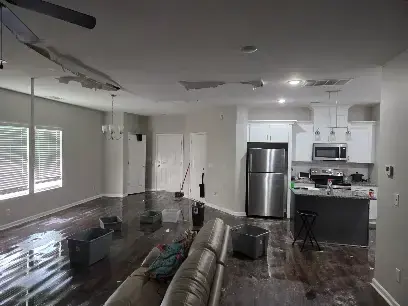
What the cleanup crew does, in order
A backup in a large Brentwood house is worked in stages so nothing is dried before it has been cleaned.
Extraction and removal
The crew removes standing wastewater first. Then porous materials that cannot be made safe again are bagged and taken out, which can include carpet, pad, insulation and the bottom of wet drywall.
Where wastewater spread into a hallway or another room, water extraction continues until the readings show the surface is no longer wet.
Disinfection
Hard surfaces and the framing left behind are cleaned and treated with an antimicrobial. This step is why a sewage job is not simply a drying job.
Drying and documentation
Once the area is clean, dehumidifiers and air movers dry what remains. Structural drying is tracked with daily readings until the framing and subfloor are dry.
Those readings, plus the photos taken at the start, make up the record the insurer will ask for.
Who to call, and in what order
A grinder pump problem usually needs two kinds of help, and they do not overlap. One fixes the equipment, and the other fixes the house.
The plumber or pump technician finds out why the pump stopped. The restoration crew deals with whatever wastewater reached the floor, the walls and the air.
Calling both early keeps the water damage from growing while the pump waits for a part or a visit.
A backup that sits overnight in a finished lower level can soak carpet pad, wick into drywall and leave an odor that is hard to remove.
- Plumber or pump technician: diagnoses the pump, the panel and the alarm, and repairs or replaces the equipment.
- Restoration crew: extracts wastewater, removes soaked materials, disinfects and dries.
- Insurance company: opened after photos are taken and before repairs are done.
- Pump service history: gather any paperwork on earlier service calls for the technician.
Protecting a large house from a spreading backup
Wastewater looks for the lowest opening. In a big two level house that is often a floor drain, a basement shower or the bathroom nearest the pump.
Closing interior doors can slow its spread into hallways and bedrooms. A rolled towel is no match for a full tank, but it can keep a thin film from crossing a threshold while help is on the way.
- Shut off the HVAC fan if its return is in the affected room, so it does not move contaminated air.
- Lift clean items off the floor only if that can be done without stepping into the wet area.
- Leave soaked carpet and pad where they are for the crew to remove.
- Wash hands with soap after any contact with the area, and keep children out.
After the pump is repaired
A working pump is only part of the recovery. The house still needs to be checked for moisture, and the owner needs a record of what happened.
Tell the plumber or pump technician what the alarm did and when, because that history helps explain the failure.
- Keep photos, receipts and drying logs together.
- Ask the insurer how it treats sewage backups before repairs start.
- Have the technician confirm the alarm light resets and the pump runs.
- Watch fixtures for slow draining in the days after the repair.